
Remembering June Jones: A Brilliant Football Mind, a Loyal Friend and a One-of-a-Kind Coach
 Steve Milton
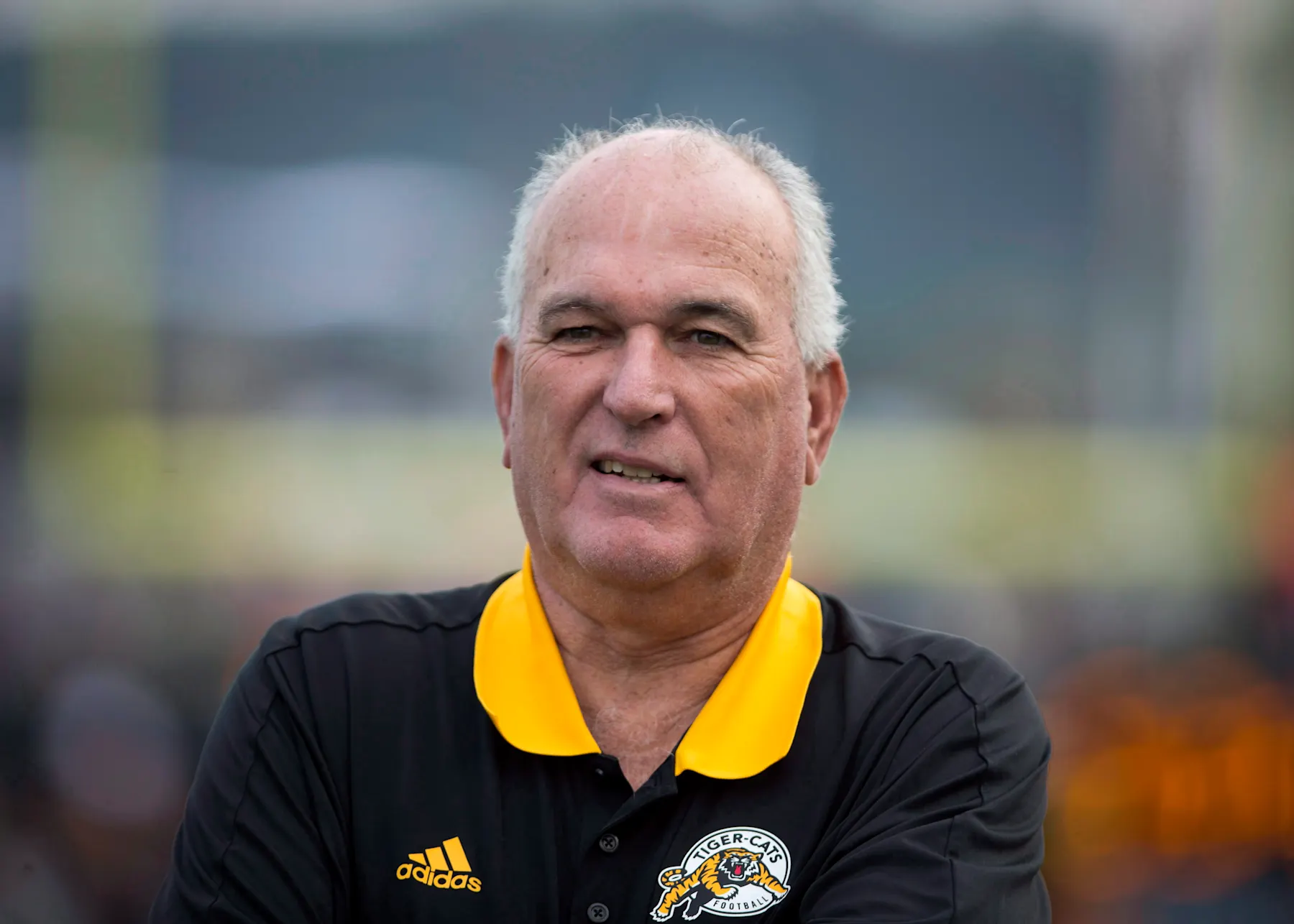
June Jones was a football lifer with a remarkable mind for the game, a treasure chest of stories and an uncommon ability to make people feel valued. His time in Hamilton may have been brief, but his influence on the Tiger-Cats, their players and coaches was anything but. In remembering Jones, we're reminded of a man whose impact went far beyond wins, losses and the innovative offence that helped define his coaching career.
Written by Steve Milton
It’s nearly a week since we got the shattering news that he was no longer with us, but June Jones’s distinctive voice is still dancing through my head.
That voice was shaped and tinged by the verbal influences of his many football stops; his native Portland, Oregon; his NFL playing days and later head coaching tenure in Atlanta; assistant coaching gigs in Detroit, San Diego and Houston; and extended big-time college head coaching stretches at Southern Methodist and, most influentially, his beloved Hawaii.
It was not a booming voice, its timbre surprisingly thin for someone of his imposing stature (6-foot-4), and often slightly cracking at its higher registers, usually when he was laughing at something he’d observed on the field or digging into his treasure chest of stories from a rich and full life, in football and outside of it.
“June was one of a kind,” says Orlondo Steinauer, the Ticats’ President of Football Operations, who was Jones’ assistant head coach in 2018 before succeeding him as head coach in 2019 with Jones stepping aside—initially to handle the offence and be an associate head coach—but leaving in May for Houston of the XFL.
“In my time around him, I can’t recall ever hearing him raise his voice at a player, and I was fortunate enough to know him personally for eight years. Obviously, he was a tremendous football mind, innovative in his thinking, calm in his demeanor, yet fiercely competitive. What always stood out to me was his consistency: how he handled adversity and the respect he showed others.
“Beyond football, June was a great friend, and I always enjoyed our conversations, text messages, and the genuine care he showed for others. You can tell by the outpouring of love and support just how much of an impact he had on so many people. He will be missed. We lost a great one.”
June Jones died in Oregon last Thursday, and his loss reverberated through the Ticats’ organization like an earthquake.
He spent less than three years in the city before the XFL beckoned, and he was concurrently convinced that Steinauer would be just fine as head coach. But while he was coaching elsewhere, his mind never left Hamilton. He had a special affinity for the city and its Ticats and, until the end, he was in constant contact with the likes of Steinauer, CEO and Managing Partner Scott Mitchell, former assistant GM Shawn Burke, his one-time college quarterback Bo Levi Mitchell, and even the former columnist at the Hamilton Spectator. He offered advice, player evaluations, insight into the rapidly changing nature of the game, tips about college players who might be better suited for CFL needs and just plain camaraderie. Wherever his primary coaching responsibilities might sit at the time, his second team was always the Ticats.
And he was thrilled when the Cats signed Bo Levi Mitchell, whom he had recruited from Katy, Texas, to play at the University of Hawaii before having a principled disagreement with school officials over what he considered their lack of commitment to the football program. So, he accepted the head coaching job at SMU in 2008 and Mitchell switched his commitment from Hawaii to the Houston campus.
“I started for him my first two college years,” said Mitchell, who then transferred to Eastern Washington. “June was a man of his word. Some coaches beat their players into the ground, others build men up and bring the best athletes out. June was that man.
“Out of everything I learned, one of the biggest was that it’s OK to make mistakes—even mistake after mistake—you just need to learn from them and keep growing. And that’s what I did at SMU with him and I would not be who I am today, as a quarterback or as a person, without him.”
While those who played for him, or coached with him, or who were around his circle became most impressed by his loyalty, his desire to make you feel comfortable and valued, and his unique perspectives on even the most mundane of situations, the outside football world centred more on his evolution of the ‘run-and-gun’ offence. He was one of the early converts to the wide-open style of play that featured only one running back, and sometimes none, with a plethora of receivers working at high tempo with ever-changing routes and reloading rapidly, with little huddle time. It was refined by Mouse Davis, who was the offensive coordinator at Portland State when Jones played there, and Jones became one of its primary disciples.
Jones was noted for developing quarterbacks and their psychic relationships to their receivers and there was no greater example of that connection than Jeremiah Masoli and Brandon Banks. When Jones moved up from assistant head coach to head coach in 2017, succeeding Kent Austin after an 0-8 start, he began with what was originally an experiment to shake things up but quickly became a permanent look. He replaced future Hall of Famer Zach Collaros with Masoli under centre and installed Speedy Banks as a full-time starter at receiver, where he’d only been used sporadically because he’d been considered too important to the return game.
The results were astonishing and immediate. They won on Labour Day, their first victory, came close to making the playoffs, and over the next three seasons no quarterback-receiver tandem in the entire CFL was as productive as Masoli-Banks. In the first eight games of the 2017 season, Banks had only eight receptions for 52 yards, and in the final 10 games after the switch he caught 59 passes for 959 yards and eight touchdowns.
Arguably, that change in personnel philosophy elevated Banks from a possible well-down-the-road Hall of Fame candidate to a Hall inductee this year in his first season of eligibility.
June Jones was one of the kindest men I’ve ever met in pro football, and I’ll emphasize that he didn’t have to be: by the time he came to Hamilton, he had compiled the kind of track record which would have allowed him to be dismissive of others with lesser credentials. But Jones was never like that; he treated people here, even guys like me—then an often-critical columnist for the Hamilton Spectator—with respect, almost as peers.
I spent a lot of time talking to June Jones, most of it listening but often serving up my own opinions or observations, which he’d duly note, nodding when he thought I was on track, quickly and bluntly correcting me when I was, in his view, way off base. All without judgment.
I’m not sure I’ve ever learned more about football in such a short period than I did during Jones’ time in Hamilton. After he left, I talked to him about several players—particularly Speedy Banks and Bo Levi Mitchell—for stories and columns but also made sure that I talked to him about life, several times a year.
Jones was a sportswriter’s absolute dream coach; he was honest in his assessments and spoke what he felt and saw because he was secure in his own skin and his football history. That same trait could also make football operations and public-relations staff very nervous. The best example came during the notorious training camp of 2018—the spring he made one of his few big mistakes in quarterback judgement, predicting Johnny Manziel had a good chance to become the best player the CFL had ever seen, before rather quickly changing his mind—when then-Ticat Vernon Adams Jr. found himself the odd man out in a three-quarterback depth chart. The PR staff had almost pleaded with him not to mention the attempts to trade him, but the first thing Jones said during the media scrum a few seconds later was that Adams was being shopped around. The trade value dropped to virtually nothing as interested teams knew they only had to wait until he was released, which he was a few days later.
A writer cherished that kind of audacity and also loved the sheer volume and depth of his personal stories from decades deep inside the highest levels of football, college and pro. He knew the game like the back of his hand and was willing to share that knowledge.
Most days in Jones’ time here, I would leave the stadium long after I’d actually finished my formal work because I’d be listening to and learning from one, or all of a stupendous coaching group that over time included the likes of colourful Jerry Glanville, quarterback guru Dan Morrison, NFL assistant coaching veteran Frank Gansz Jr, NFL vet Dennis McKnight, CFL special teams maestro Jeff Reinebold, and rising star Orlondo Steinauer. It was as if Hamilton was Coaching Central of the entire continent.
It was a daily multi-faceted tutorial in what matters about the game and its nuances, most of which I’d never have known without Jones. If you didn’t have more knowledge about football or its participants at the end of every day than you did at its start... you had not been paying attention to the gift right in front of you.
Regrettably, I did not get a chance to take Jones up on his repeated invitations to visit him if I was ever in Hawaii during the off-season. And it will continue to be difficult for me to imagine a world, and a Hawaii, without June Jones.
Even when I didn’t see him, I knew he was there, which made the football world feel right.